
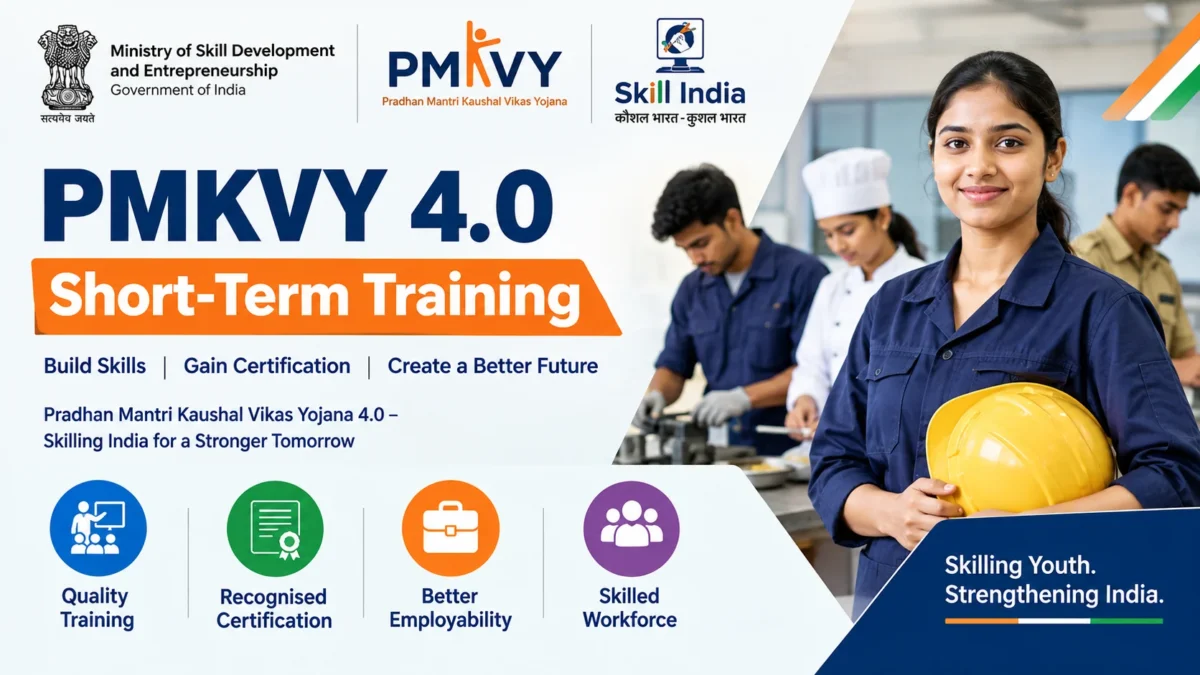
What is PMKVY 4.0 Short-Term Training?
Short-Term Training (STT) is the main classroom-plus-workplace course under Pradhan Mantri Kaushal Vikas Yojana (PMKVY) 4.0. The Ministry of Skill Development and Entrepreneurship (MSDE) runs the scheme, and the National Skill Development Corporation (NSDC) supports it as the implementing arm. According to the guidelines, PMKVY was launched in 2015 and PMKVY 4.0 is being implemented between FY 2022-2026 under the Skill India Programme. STT is meant for school or college dropouts, out-of-education candidates and unemployed youth of Indian nationality, and also for people who want to re-skill or upskill.
It is not a loan, not a cash-benefit scheme and not a job guarantee. The guidelines describe training, assessment and certification, plus linkage to jobs, but no wage or stipend for candidates. Not everyone qualifies, because there are age, Aadhaar and job-role conditions.
Older documents and some centres use the terms Training Provider (TP) and Training Centre (TC). The 2025 assessment SOP calls them Project Implementing Agency (PIA) and Skill India Centre (SIC). It also calls the digital platform Skill India Digital Hub (SIDH), while the guidelines say Skill India Digital (SID). This post uses TP, TC and SID.
Scheme overview
| Item | Details |
|---|---|
| Name | Pradhan Mantri Kaushal Vikas Yojana 4.0, Short-Term Training component |
| Earlier versions | Three versions were implemented between 2015 and 2022 |
| Launched | PMKVY 4.0 runs under the Skill India Programme, approved by the Union Cabinet (see PIB release below |
| Ministry / agency | MSDE (policy); NSDC (implementation); NCVET (regulation of awarding bodies and assessment agencies) |
| Total budget | Rs. 8,800 crore for the overall Skill India Programme, 2022-23 to 2025-26 (PMKVY 4.0 is one component). |
| Target | Dropouts, out-of-education and unemployed youth of Indian nationality; also re-skilling and upskilling. |
| Applicable period | FY 2022-2026, as per the guidelines. Whether extended: No extension officially notified as of September 2026. |
| Mode of delivery | Registration on Skill India Digital or its mobile app; training at accredited centres, mostly in physical mode |
The guidelines describe three routes. STT is the focus of this post.
| Route | Who it suits | Course format |
|---|---|---|
| Short-Term Training | Fresh skilling, re-skilling, upskilling | 300 to 600 hours, NSQF-aligned, with on-the-job training |
| Recognition of Prior Learning (RPL) | People who already have experience in the job role and want certification. Age band is 18 to 59 | Assessment plus a short orientation of at least 30 hours and at most 132 hours |
| Special Projects | Marginalised and vulnerable groups, difficult geographies, new-age job roles | Project-based, set by the Executive Committee |
The guidelines say courses of longer duration can be offered where industry demand exists.
Who benefits and how much
The guidelines do not give a cash amount payable to a candidate. Support is in the form of paid-for training and services. Where a rupee figure appears, it is usually paid to a provider, vendor or insurer, and the table says so.
| Support | Who gets it | Detail as per the guidelines | Paid to |
|---|---|---|---|
| Training | Enrolled candidates | Cost is met by the scheme. Rates are in the providers section below | Training provider |
| Assessment and one re-assessment | Candidates | Assessment fees are funded under the scheme. Every candidate gets one free re-assessment chance | Awarding body / assessment agency |
| Induction kit and participant handbook | All candidates | T-shirt (male) or jacket (female), and a bag. Up to Rs. 500 per candidate | Vendor |
| Certificate | Candidates who pass | Digital QR-code certificate. One printed copy free of cost from the training provider | Not applicable |
| Accidental insurance | See note below | One year of cover. Premium of Rs. 14.16 at prevalent rates | Insurance company |
| Boarding, lodging and transport | Women, PwD and candidates in Special Areas, as per Common Norms. May be extended to aspirational, border, tribal-dominated and LWE-affected districts | As per Norms | Training provider |
| Conveyance | Women and PwD in non-residential training | As per Common Norms. | Candidate |
| Assistive devices | PwD candidates | Rs. 5,000 towards devices, aids and appliances | Training provider |
| Counselling and digital content | All registrants | Online counselling on Skill India Digital; digital content to supplement classes | Not applicable |
| Post-certification tracking and job linkage | Certified candidates | See ‘Will I get a job?’ in the FAQs | Rs. 50 per certified candidate goes to NSDC, not to you |
Accidental insurance: paragraph 6.3 says every certified candidate gets one year of cover, while Annexure III lists coverage for all candidates. Ask your centre which applies.
Am I eligible?
| Condition (as per the scheme guidelines) | Your answer |
|---|---|
| I am an Indian national | Yes / No |
| I am aged 15 to 45 years | Yes / No |
| I have a valid Aadhaar | Yes / No |
| I have a mobile number for OTP-based eKYC verification during registration | Yes / No |
| I am a school/college dropout, out-of-education, or unemployed, or I want to re-skill or upskill | Yes / No |
| I meet the criteria set for my chosen job role | Yes / No |
| I have not already been trained in the same job role | Yes / No |
| I have not used up my re-enrolment limit (see step 10) | Yes / No |
If any answer is No, you may not be able to enrol in that course, so check the job-role criteria and your options with online counselling before you register. Only one exception to the Aadhaar rule is stated: Special Projects may allow other IDs in exceptional cases such as jail inmates, with Executive Committee approval.
Do I need to apply?
Yes, and it is a digital process. The guidelines say candidates register on Skill India Digital or its mobile app. Who does what:
| Party | Role |
|---|---|
| You | Register, verify by mobile OTP, choose a course and centre, attend, appear for assessment |
| Skill India Digital | Checks for duplicates, offers online counselling, matches you to the nearest centre, hosts your certificate |
| Training centre | Runs the batch, records biometric attendance, arranges on-the-job training, prepares you for assessment |
| Awarding body and assessment agency | Conduct the assessment and issue results and certificates |
| NSDC | Tracks certified candidates for one year and handles grievances |
The PMKVY 3.0 guidelines described offline application at a Training Centre. The 4.0 guidelines do not mention an offline route, so treat a centre’s own sign-up as a first step only, and complete your registration on the portal or app.
Step by step: what you must do
| Step | What to do | Source detail |
|---|---|---|
| 1 | Check the eligibility table above | |
| 2 | Register on Skill India Digital or the mobile app, and verify by mobile OTP | Some details are fetched from other portals such as e-Shram and National Career Services |
| 3 | Use online counselling to pick a course and a centre | Compare job roles, centre rating, profile, facilities, trainers and past training record |
| 4 | Confirm enrolment and read your profile page | It should show the course outline (theory and practical hours), trainer details, facilities such as conveyance or boarding, induction kit contents and raw materials |
| 5 | Attend every session and give biometric attendance on entry and exit | You need more than 70% biometric attendance to appear in the assessment. Batches are 10 to 30 candidates |
| 6 | Complete on-the-job training where your job role requires it | Your centre must tie up with an establishment. If none exists nearby, project work can replace it |
| 7 | Appear for the assessment | It is held after on-the-job training. There is no separate assessment of OJT |
| 8 | If you do not pass, ask about re-assessment | One free chance. Your centre must submit you within 15 calendar days of results (SOP) |
| 9 | Download your certificate | Digital certificate via DigiLocker, an emailed or SMS link, or your Skill India Digital profile |
| 10 | After certification | Your details are available to employers on the portal, and you can be linked to Rozgar Melas and Apprenticeship Melas. Re-enrolment: at most twice under PMKVY in the same sector, the second time only in a higher NSQF-aligned job role, or a fresh course in a different area. A six-month gap between the first certification date and the next batch start date is required |
How you are graded. The guidelines give grades for candidates who pass.
| NSQF level | Grade A | Grade B | Grade C |
|---|---|---|---|
| Levels 1, 2, 3 | 85% and above | 70% to below 85% | 50% to 70% |
| Level 4 and above | 85% and above | 70% to below 85% | Not listed |
The exact pass mark for STT is not written as a separate rule. The table implies it, but please verify with your awarding body.
Timelines in the 2025 assessment SOP (STT). These bind the institutions, not you, but they tell you what to expect.
| Stage | Timeline |
|---|---|
| Batch assigned to an assessment agency | Within 10 days of batch creation |
| Assessment agency accepts the batch | Within 3 days |
| Assessor assigned | Within 2 days of acceptance |
| Mock assessment paper shared with your centre | Within 3 days of the agency being aligned to the batch |
| Assessment | Within 1 day of training completion |
| Results submitted by the agency | Within 3 days of assessment |
| Results published by the awarding body | Within 2 days of submission |
| Certificate | Generated automatically once results are published |
By our arithmetic, results should be out within about five days of the assessment, unless a reported exception applies. The SOP also allows a batch to be extended by at most 15 days, and postponed only once. Beyond that the batch is cancelled automatically and candidates must re-enrol through the standard process.
Documents required
The guidelines do not give a document list. They say eligibility depends on the criteria of the job role.
| Document | Status |
|---|---|
| Valid Aadhaar | Required |
| Mobile number able to receive an OTP | Required for eKYC |
| Proof of age, education or experience needed for your job role | Depends on the job role. Check the eligibility section of your chosen course on Skill India Digital. |
| Bank account | Not listed as a requirement for candidates in the guidelines |
Why might you not get the benefit?
These are likely causes based on the scheme rules, not certainties.
| Likely cause | What to check |
|---|---|
| Age outside 15 to 45 | Your age and the reference date |
| Aadhaar missing, invalid or not verifying by OTP | Your Aadhaar details and the mobile number on it |
| Duplicate registration | You cannot be enrolled again in a job role where you were trained earlier |
| Re-enrolment limits | Maximum two job roles, six-month gap, and a lower NSQF level in the same sector is discouraged |
| Attendance not recorded | Biometric punch on entry and exit every day. The guidelines say more than 70% is required, and another paragraph mentions 70% so aim for well above 70% |
| Batch extended past the limit | Ask your centre whether your batch is still active on the portal |
| Assessment not passed | Ask whether your centre has applied for your re-assessment in time |
| Job-role criteria not met | Read the eligibility line for your course before you enrol |
| Special support does not apply to you | Boarding, lodging, transport and conveyance are meant for specified groups and areas, not all candidates |
| Job not obtained after certification | The guidelines delink placement from skilling and only provide linkages, so a job is not part of the scheme’s promise |
For training providers and institutions
Who can be a provider. The guidelines say any legally established society, trust, proprietorship, company, LLP or government institute can be a training provider. Skill Hubs may be set up in schools, colleges, universities and other higher education institutions. Private providers must qualify accreditation and affiliation norms and be onboarded on Skill India Digital before targets are allocated. They must not be blacklisted. Government institutions and Skill Hubs are exempt from accreditation and affiliation but must register on the portal.
Before a batch starts. The guidelines require full enrolment as per a batch size of 10 to 30, a handbook or study material, a functional lab, a certified trainer, OJT tie-ups where applicable, and a working AEBAS device registered on the NIC platform.
Money flow. All figures are per candidate, from the guidelines and Annexure IV.
| Item | Amount |
|---|---|
| Indicative cost, STT 300 hours (also Skill Hubs) | Rs. 9,540 |
| Indicative cost, STT 450 hours | Rs. 13,724 |
| Base training rate | Rs. 27.89 per hour |
| Assessment and certification (to SSC/awarding body) | Rs. 600 per assessment |
| AEBAS transaction fee | Up to Rs. 10 per user |
| Payout to training provider, tranche 1 | 30% on commencement of training |
| Tranche 2 | 30% when the batch achieves 70% AEBAS attendance once and 50% of training is over |
| Tranche 3 | 40% on certification (passed candidates only) |
| On-the-job training organised | 50% of applicable base hour cost per candidate |
A Skill Hub that fails to train against its allocated target can have the released amount, or a proportionate part, recovered.
Compliance. Annexure V lists penalty levels. High: a centre that does not exist, subletting (franchising is not allowed), fake or mass enrolments, missing tools while a batch runs, and influencing assessors. Medium: not distributing induction kits or handbooks, not using AEBAS, and admitting regular candidates. Low: not following branding guidelines. Under the SOP, delays by awarding bodies, assessment agencies and assessors attract financial penalties, and a centre that reschedules a batch more than three times in a financial year faces a flat 10% penalty on the batch fee for each subsequent delay.
Candidate protections. NSDC uses call validation, CCTV monitoring, virtual verification and physical visits, and grievances can be lodged through a module on Skill India Digital or the Skill India Portal.
Current status
| Item | Figure | Source |
|---|---|---|
| Youths trained under the three earlier versions, 2015 to 2022 | More than 1.37 crore (government-reported) | PMKVY 4.0 guidelines, Chapter I |
| Enrolments, certifications or payments under PMKVY 4.0 | No consolidated official figure found” with the source cell blank, or delete the row. | PMKVY 4.0 guidelines |
| Assessment SOP issued | 24 February 2025, by MSDE (PMKVY Division), with the approval of the Secretary | Office Memorandum |
The guidelines say PMKVY 4.0 runs between FY 2022-2026. If you are reading this after that period, check the official portal for any extension or successor scheme.
Benefits and limits
| Advantages | Caveats |
|---|---|
| Workplace exposure is built into the course, not an add-on | Availability of job roles and seats depends on the centre and district |
| Independent assessment bodies, not your own trainer, test you | Support amounts for conveyance, boarding and lodging are not in the guidelines |
| QR-code digital certificate, available without visiting the centre | Timelines in the SOP can be relaxed for reported unavoidable circumstances |
| Monitoring and a grievance channel exist for candidates | The scheme’s period is stated as FY 2022-2026 |
| A second chance is built in, through free re-assessment and re-enrolment | You must clear attendance, assessment and re-enrolment rules yourself |
FAQs
Is there a fee for STT?
The guidelines do not mention any fee for STT candidates, and say training, assessment and re-assessment costs are met from the scheme. The PMKVY 3.0 guidelines mentioned fee-based higher-level courses, so ask your centre to confirm in writing before you enrol.
Do I get any stipend or cash?
The guidelines do not provide one. Money listed for candidates is limited to conveyance for specified groups, and its amount is not stated.
Can I take a second course?
Yes, within the limits: at most two job roles, with a six-month gap after your first certification. The second must be a higher NSQF-aligned job role in the same sector, or a different course.
I am above 45. Is there any route?
RPL has an age band of 18 to 59, but it needs prior experience in the job role and is a certification route, not a full course.
What if I fail the assessment?
You get one free re-assessment. Ask your centre whether it has submitted your name within the 15-day window in the SOP.
What if my batch is postponed?
A batch can be extended by up to 15 days and postponed once. Beyond that it is cancelled and you must re-enrol.
Where do I complain?
Through the grievance module on Skill India Digital or the Skill India Portal. NSDC runs a national grievance desk, and serious cases go to the Executive Committee.
Will I get a job?
The guidelines delink placement from skilling. After certification you get portal visibility to employers, Rozgar and Apprenticeship Melas, and periodic tracking calls for one year.
What to do now
- Check age, Aadhaar and your mobile number, then register on Skill India Digital or the app.
- Before you enrol, ask the centre for written details of the job role, hours, on-the-job training arrangement, fee (if any) and induction kit.
- Keep proof of your biometric attendance and your batch details, and follow up on results and re-assessment if needed.
Official sources
- PMKVY Training Centre list: https://www.pmkvyofficial.org/trainingcenter
- Guidelines for Pradhan Mantri Kaushal Vikas Yojana 4.0 (MSDE) : Check Pdf
- Office Memorandum dated 24.02.2025 with SOP for Assessment and Certification under PMKVY 4.0: Check Pdf
- Skill India Digital portal: Click Here
- PIB or ministry release: Click Here