

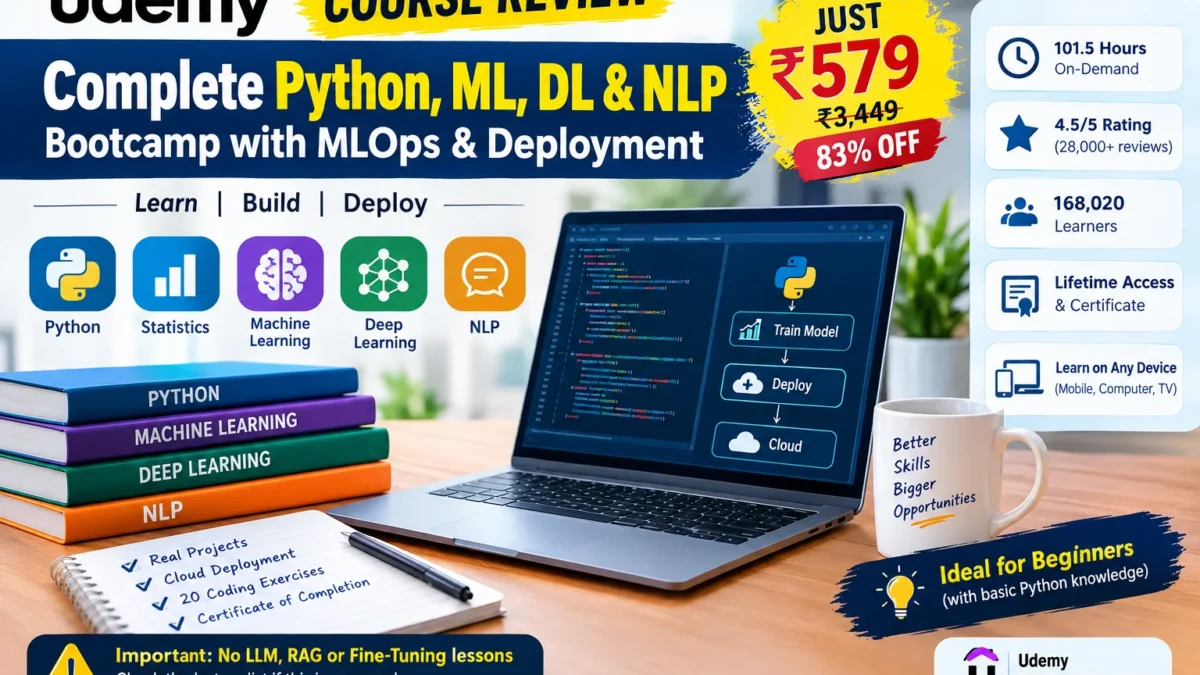
This is a 101.5-hour Udemy course that teaches Python, statistics, machine learning, deep learning and NLP in one place, then deploys projects to the cloud. It suits beginners who already know a little Python. It will not make you a GenAI engineer on its own. Check one thing before you pay: the lecture list has no LLM, RAG or fine-tuning lessons. If that is your goal, read the gaps section first.
Is it available now?
| Check | Status on 1 October 2026 |
|---|---|
| Enrolment | Open. It is an on-demand course with no start date or last date. |
| Page last updated | August 2026 |
| Price on the page | A sale price with a 23-hour countdown |
| Verify before paying | Current price, rating, and whether the lecture list has changed |
Quick overview
| Detail | What the page says |
|---|---|
| Provider | Udemy |
| Instructor | KRISHAI Technologies Private Limited, founded by Krish Naik |
| Level | Beginner to advanced |
| Length | 101 hours 27 minutes of video, 64 sections, 436 lectures |
| Mode | Online, self-paced, on phone, computer and TV |
| Language | English, with auto captions in several other languages |
| Price | ₹579 (shown as 83% off ₹3,449) |
| Other plan | Udemy Personal Plan, from ₹500 a month |
| Extras | 20 coding exercises, 2 role plays, 19 articles, 167 downloadable files |
| Access | Lifetime |
| Certificate | Certificate of completion |
| Rating | 4.5 out of 5 from about 28,000 ratings; 168,020 learners |
| Requirements | High-school algebra and statistics, programming basics (Python preferred), a computer with internet |
| Enrol | udemy.com/course/complete-machine-learning-nlp-bootcamp-mlops-deployment/ |
About the instructor
| Detail | What the instructor profile says |
|---|---|
| Name on Udemy | KRISHAI Technologies Private Limited |
| Founder | Krish Naik |
| Experience | The profile states over 13 years in data analytics and more than 7 years of teaching |
| Reach | 548,893 total learners and 108,219 reviews on the profile |
| Subjects | Data science, machine learning, generative AI, deep learning, NLP |
These are the instructor’s own claims. Learner and review numbers show reach, not quality. The profile lists generative AI as a focus area, yet this course’s lecture list has no LLM lessons, so that training is not part of this purchase.
Who it suits and who should skip
| Good fit | Skip or add something else |
|---|---|
| A beginner with basic Python who wants one course from statistics to deployment | Anyone who wants to build chatbots or LLM apps, since the lecture list doesn’t cover them |
| A BTech, BCA or MCA student building a first ML portfolio | Anyone who needs a mentor, live doubt sessions or placement help, since the page mentions none |
| A working developer moving into ML. One reviewer who is a backend developer found it useful. | Someone who already knows Python and pandas, who can skip about 16 hours of the early sections |
| A learner who wants the maths behind each algorithm explained | Someone who wants short, practical lessons with little theory |
Where the 101 hours go
Approximate hours per block, calculated from the lecture durations listed on the course page. The total matches the page’s stated 101 hours 27 minutes.
| Block | Approx. hours | What it covers |
|---|---|---|
| Setup and tools | 0.8 | Anaconda, VS Code, virtual environments |
| Python and OOP | 9.5 | Data types, functions, classes, decorators, generators |
| Libraries and app basics | 6.7 | NumPy, pandas, Matplotlib, Seaborn, SQLite, logging, threading, Flask, Streamlit |
| Statistics and probability | 8.3 | Distributions, hypothesis testing, ANOVA, Bayes theorem |
| Data cleaning and EDA | 3.0 | Missing values, outliers, encoding, four dataset walkthroughs |
| Supervised ML | 21.6 | Regression, SVM, Naive Bayes, KNN, trees, random forest, boosting, XGBoost |
| Unsupervised ML | 4.2 | PCA, K-means, DBSCAN, anomaly detection |
| Docker and Git | 2.5 | Containers, images, Compose, merge conflicts |
| Projects, deployment, MLOps | 14.5 | Full ML project, AWS and Azure deployment, ETL, MLflow, DVC, BentoML |
| Classical NLP | 6.4 | Tokenisation, bag of words, TF-IDF, Word2Vec, two text projects |
| Deep learning basics | 9.0 | Neural networks, activations, optimisers, CNN theory, ANN projects |
| RNN, LSTM, GRU, attention | 7.7 | Sequence models, encoder-decoder, attention |
| Transformers | 5.0 | Encoder and decoder architecture |
| Claude Code | 2.3 | Installing and using an AI coding tool |
Supervised ML is the biggest block, about a fifth of the course, so you get real depth there. The modern AI material is much thinner.
What the page promises and what the lecture list shows
| The page says | The lecture list shows |
|---|---|
| Covers reinforcement learning | No lecture title mentions it |
| Uses TensorFlow, PyTorch and scikit-learn | Lectures use scikit-learn and Keras/TensorFlow. No PyTorch lecture title. |
| Real-world projects in healthcare, finance and e-commerce | Named projects include diabetes prediction, flight prices, Play Store apps, wine quality, and review sentiment. No finance project appears in the lecture titles. |
| 20 coding exercises | The twenty problems listed are basic Python tasks on lists, dictionaries and tuples, not ML tasks |
| Transformer models | About 5 hours of architecture theory. One reviewer says there is no hands-on work after encoder-decoder and transformers. |
| Nothing on Claude Code in the “what you’ll learn” list | Seven lectures, about 2 hours 17 minutes, on installing and using Claude Code (agents, hooks, skills, plugins). It teaches a tool, not how to build GenAI products. |
Eligibility check
| Question | Yes / No |
|---|---|
| Can I write simple Python (loops, functions, lists)? | Yes / No |
| Am I comfortable with school algebra and basic statistics? | Yes / No |
| Do I have a computer with internet? | Yes / No |
| Can I spend about 8 to 10 hours a week for three to four months? | Yes / No |
If the answer on Python is No, the course does teach it in about 9.5 hours. Still, one reviewer says you should already know basic coding, so spend a week or two on basics first. If maths is a weak area, the statistics block is long and one reviewer found the maths practice thin, so add practice problems from another source.
What it costs
| Item | Detail |
|---|---|
| Single course | ₹579 on the page snapshot |
| Personal Plan | From ₹500 a month. It opens 28,000+ courses, so it only pays off if you will take several. |
| Refund | 30-day money-back on single courses |
| Extra costs | The deployment lectures use AWS and Azure. Cloud services can bill you if you leave resources running, so set a billing alert. |
Udemy runs sales all the time. One deal-tracking site says sitewide sales roll over roughly every 3 to 4 days. Udemy’s own community staff explain that courses in its Deals programme can be discounted whatever list price the instructor sets. So treat ₹3,449 as a reference figure, and don’t rush because a timer is running.
On refunds, Udemy has a 30-day money-back policy for individual courses. It can reject a request when a large part of the course has been consumed or when many refunds have been requested. Third-party guides add that refund requests can’t be made from the mobile app, and that subscription plans get no full or partial refunds. Confirm the current rules on Udemy’s support pages before buying, and start a refund early if you need one.
Certificate
You get a certificate of completion. Udemy is not an accredited institution, and its certificates can’t be used for formal accreditation. A review site notes that no outside partner verifies them. So the certificate shows that you finished the videos, nothing more. A recruiter will look at your projects, not the PDF.
Jobs and outcomes
The page makes no placement or job claim. Its description says you will have the skills to pursue a career in ML and NLP, which is a claim about skills, not a promise of a job. One reviewer wrote that they would get placed after the course. A review is not evidence.
For a sense of what employers ask, compare it with the Infosys GenAI Developer Job in Bangalore 2026. That role lists machine learning, deep learning, Python, data analysis and cloud as good-to-have skills, and this course covers all five. Its primary skills are LLMs, agentic AI and NLP. This course covers NLP, but has no dedicated LLM or agent-building lessons. That role also asks for 9 to 15 years of experience, so it is not a first-job target. The course is a foundation, not the finish.
What reviewers say
I read the 36 reviews shown on the page. Of these, 19 gave 5 stars, 5 gave 4.5, 6 gave 4, 2 gave 3.5, 2 gave 2.5, 1 gave 2 and 1 gave 1. It is a small sample of the 28,000 ratings.
| Theme | What reviewers say |
|---|---|
| Praise | Clear, patient teaching. Reasons behind each method are explained. Good for beginners. Several reviewers like the maths intuition. |
| Content complaints (6 reviews) | Few hands-on projects after transformers. Heavy on maths, light on real-time projects. The instructor skips “why” for basics. Some exercises use material not taught. Some videos end mid-topic. The maths section lacks practice questions. |
| Technical complaints (2 reviews) | App not working, video pausing. These concern the app, not the teaching. |
| Not useful | One review says the writer was given someone else’s login. Ignore it, and don’t buy shared accounts. |
How to enrol
- Open the course page on udemy.com from a computer, not the app.
- Read the full curriculum and play the opening lectures to check the teaching style.
- Decide between the single course and the Personal Plan. A single purchase is simpler if this is your only course.
- Check the price, pay, and note the date so you know when your 30-day refund window ends.
- If the course isn’t right for you, request a refund early, from Purchase History on a computer.
Common mistakes
| Mistake | Why it hurts |
|---|---|
| Buying it to learn LLM or GenAI apps | The lecture list doesn’t cover them |
| Watching at 2x without coding along | You will feel fluent and forget it in a week |
| Copying the course projects to your resume | Every learner has them. Use a different dataset. |
| Leaving AWS or Azure resources running | It can create a bill |
| Buying a shared login or a “free” copy | The account can disappear, and you get no refund |
| Skipping statistics because it is long | Interviews for ML roles often test it |
Is it worth it?
For ₹579, yes, if your goal is a solid base in classical ML, statistics, deployment and NLP basics. The money risk is small. The real cost is 100+ hours of your time, so be honest about whether you will finish. It is a weaker choice if you want modern GenAI skills, need mentoring, or already know Python and scikit-learn.
A 12-week plan
A suggested pace of about 9 hours of watching a week. Add coding time on top.
| Weeks | Sections | What to build |
|---|---|---|
| 1 to 2 | Python, OOP, libraries (skip what you know) | Solve the listed exercises without looking at answers |
| 3 to 4 | Statistics and EDA | Clean and explore one new dataset |
| 5 to 8 | Supervised and unsupervised ML | A regression and a classification project, each with a written README |
| 9 to 10 | Docker, Git, deployment, MLOps | Deploy one model to a cloud service and keep the repo public |
| 11 to 12 | NLP and deep learning | A text classifier on your own data |
On your resume, give each project one line: the problem, the model, the score, and where it is deployed. The deployed project will be your strongest item.
Scam warning
Buy only on udemy.com. Avoid “free course” groups on messaging apps, reseller sites, and anyone offering a certificate plus a job guarantee. Udemy’s own certificate carries no such promise.
FAQs
| Question | Answer |
|---|---|
| Is the English easy to follow? | Yes, according to several reviewers, who call the explanations easy to follow. The page lists English audio, with auto captions in other languages, and does not mention a Hindi version. |
| Do I need to know Python first? | The page says Python familiarity is preferred. The course teaches basics, but reviewers say some coding knowledge helps. |
| Is the maths heavy? | Statistics takes about 8 hours and most algorithms get a maths lecture. Reviewers are split: some like it, one wanted less. |
| Does it cover cloud platforms? | The lecture list shows AWS (Beanstalk, EC2, ECR, S3) and Azure. It shows no Google Cloud lecture. |
| Are there solutions for assignments? | Several lecture titles say “with solutions”. |
| Can I ask the instructor questions? | The page mentions no mentoring or live support. |
| What if the course is updated? | It was last updated in August 2026, and the lecture list ends with a Claude Code section. Lifetime access covers updates, so check what’s new before you buy elsewhere. |
